
Why you should have an ultrasound when you are in pain
Hello. I am Dr. Wonsik Ahn, director of ANSim Pain Clinic.
In this post, I will explain why you should have an ultrasound when you are in pain.
Even if your bones look normal on an X-ray, the cause of your pain may still be there. Ultrasound directly shows the "soft tissues" beneath the skin, so it is the least burdensome first test for finding the cause, rather than judging only by whether something hurts or not. This post uses "tumors" as an example to explain why.
1. Even if an X-ray is "normal," the cause of your pain may still be there.
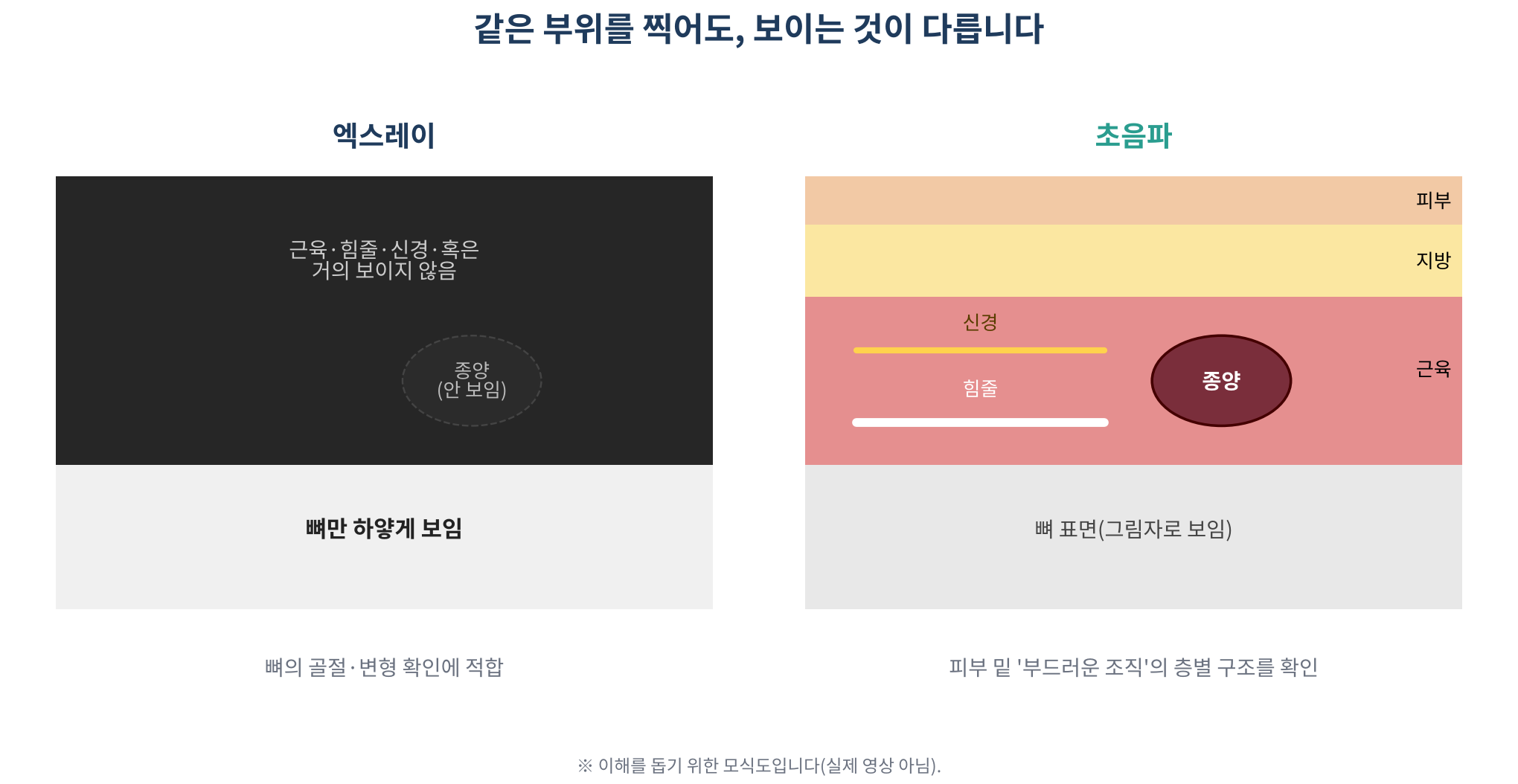
An X-ray is a test for looking at bones. It shows well whether there is a fracture or a bone deformity, but it shows almost nothing about problems in muscles, tendons, nerves, blood vessels, or subcutaneous tissue. So the statement "there is nothing wrong with your bones on the X-ray" means "the bones are not the cause," not "there is no reason for the pain."
In our bodies, pain far more often comes from the soft tissues around the bones than from the bones themselves. Ultrasound is the test that lets us see these soft tissues, layer by layer, as they actually are.
[Figure 1. An X-ray shows only bone; ultrasound shows the layers of soft tissue beneath the skin]
Take tumors as an example: pain appears late, and unreliably.
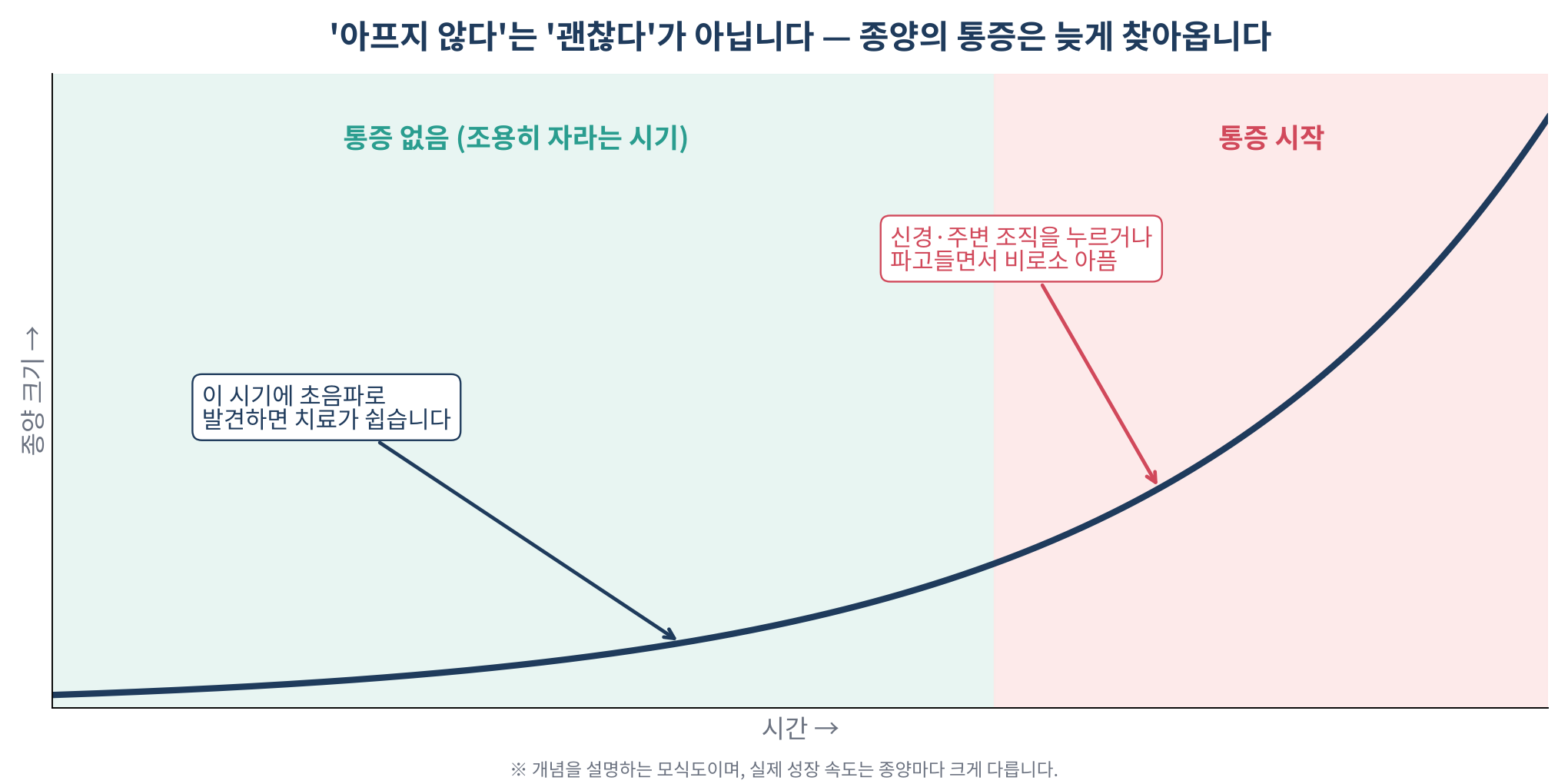
Even when a lump (tumor) forms in the body, it is usually painless at first. Pain often appears only when the lump grows and presses on nearby nerves or blood vessels, or, if malignant, when it begins to invade surrounding tissue. In other words, pain is a signal that comes not right after a tumor forms, but after it has grown to some extent.
[Figure 2. A tumor grows without pain, and pain begins only when it presses on or invades its surroundings]
There is one more important point. Pain alone cannot tell a benign tumor from a malignant tumor (cancer). Both are silent in the early stages, and when pain does occur, it can occur with either benign or malignant tumors.
Comparison | Benign tumor | Malignant tumor (cancer) |
|---|---|---|
Early pain | Usually none. Often found as a painless lump that can be felt | Usually none. Often progresses without symptoms and is found during a health checkup or similar |
Why pain occurs | When the lump grows and presses on surrounding tissue, blood vessels, or nerves | When it invades surrounding tissue or nerves, or spreads to bone and elsewhere |
Nature of the pain | Mainly dull pain, such as heaviness, stiffness, or a foreign-body sensation | Dull at first, becoming sharp and severe as it progresses. Tends to be worse at night or respond poorly to painkillers |
Exceptions | Some benign tumors, such as schwannomas, cause very severe pain even when small | Some cancers, such as inflammatory breast cancer, can cause swelling, warmth, and pain from the early stages |
This table points to one conclusion. Neither "it doesn't hurt, so it must be fine" nor "it hurts, so it must be cancer" is an accurate judgment. Whether there is pain, and how much, is only reference information; what is actually there must be confirmed directly with imaging.
3. A "painful lump" is more often not a tumor, which is why it needs to be distinguished more precisely.
If you suddenly feel a lump that hurts, it is more likely to be simple inflammation, an abscess (pus), or an inflamed or infected cyst than a tumor. That is reassuring news, but there is one problem. These three are treated differently. Cysts and pus need treatment to drain their contents, inflammation is treated with medication, and a suspected tumor needs a detailed workup. In the end, you need to know "what it is" to decide "how to treat it."
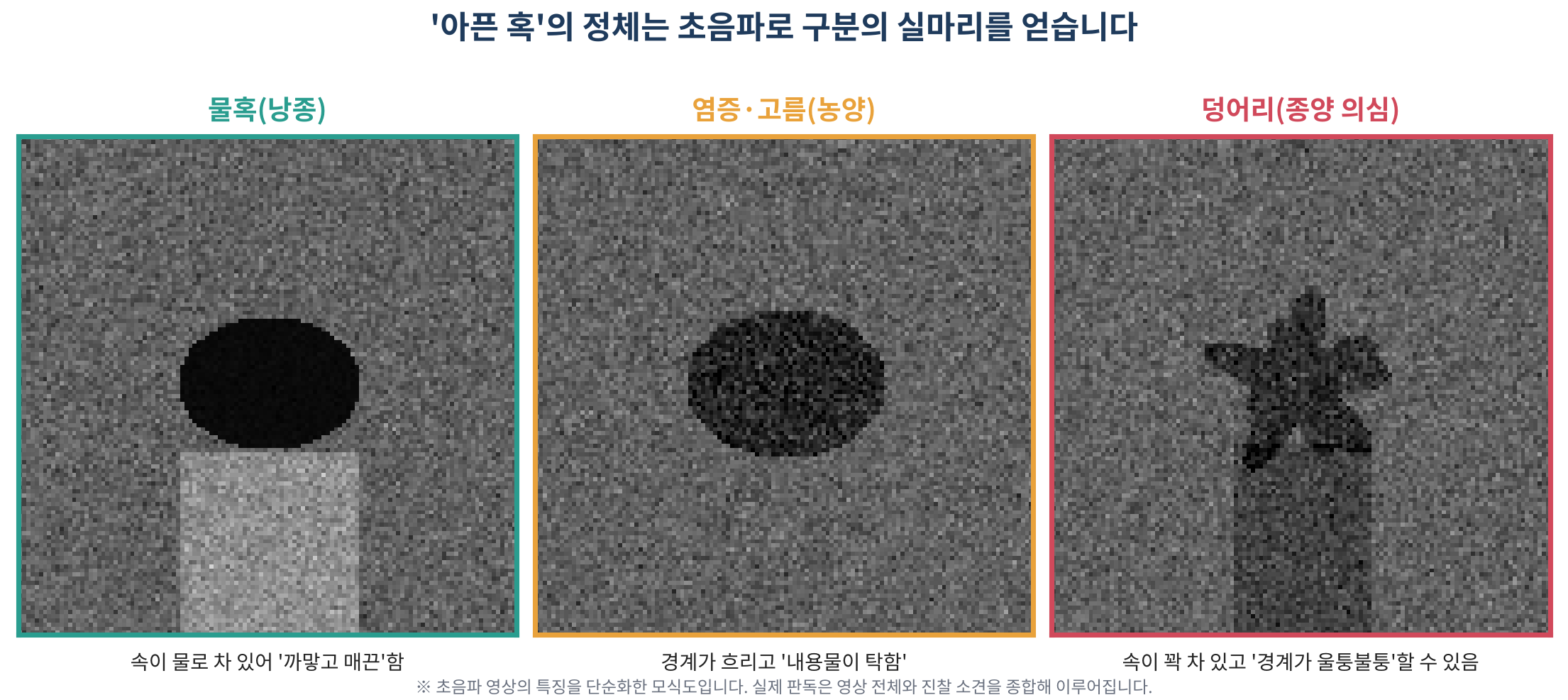
Ultrasound shows the decisive differences among these three. A cyst is filled with fluid, so it looks black and smooth; pus has blurred borders and cloudy contents; and a solid mass is filled in and may be irregular in shape. These features cannot be identified by touch; you need imaging to get clues for telling them apart.
[Figure 3. Cysts, pus, and solid masses look different on ultrasound]
4. Why ultrasound is suited to this job
It looks directly at soft tissues. It checks the size, location, and shape of the skin, fat, muscles, tendons, nerves, and any lump all at once.
It can look while pressing on the painful spot. What you say ("it hurts when you press here") can be matched with the image, which makes it easier to find the cause.
It shows movement in real time. We can directly see how tendons and muscles respond while you move a joint or tense a muscle.
There is no radiation. Follow-up scans can be repeated as needed, and the affected side can be compared with the other side.
It can lead straight to the next step right after the scan. If fluid or pus is seen, it can be drained under image guidance, and if a tumor is suspected, the biopsy site can be pinpointed accurately.
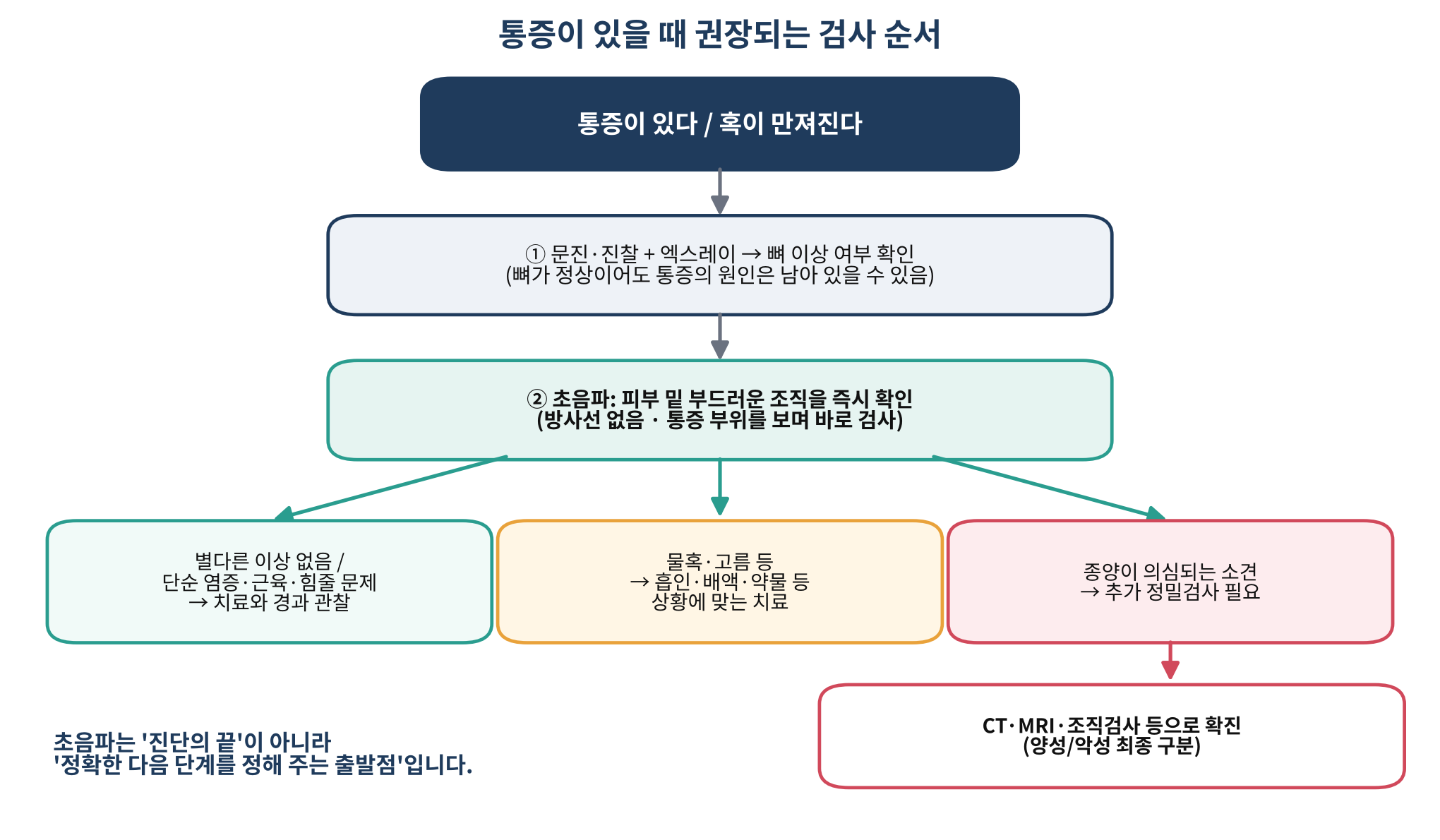
However, ultrasound also has limitations. Very deep areas, the inside of bones, and areas hidden by air (gas) may not be seen well, and ultrasound findings alone cannot confirm whether a tumor is benign or malignant. That is why ultrasound is not "the end" but "the starting point that determines the right next step."
5. The recommended order of tests when you are in pain
History and physical exam + X-ray: First, check whether there is a fracture or deformity in the bones.
Ultrasound: If pain remains even though the bones are normal, or if a lump can be felt, check the soft tissues of the painful area right away.
Next steps depending on the results: If there is no major abnormality, treatment and observation; if it is fluid or pus, aspiration or drainage; and if a tumor is suspected, a confirmed diagnosis with CT, MRI, or biopsy.
[Figure 4. The recommended order of tests when you are in pain]
6. Frequently asked questions
My X-ray is normal. Do I need another test?
=> Yes. An X-ray looks at bones, and ultrasound looks at the soft tissues around the bones. One cannot replace the other; they have different roles.
If I can feel a lump but it doesn't hurt, can I skip the test?
=> No. Tumors are often painless in the early stages, so leaving a lump alone because it doesn't hurt is the most dangerous choice.
Can an ultrasound tell me right away whether it is cancer?
=> Ultrasound is a test that determines whether something is suspicious and what the next step should be. A final diagnosis of benign or malignant is made with additional tests such as a biopsy.
If I am in pain, does that always mean cancer?
=> No. Most pain has common causes, such as inflammation or problems with muscles and tendons. We perform ultrasound to accurately identify even those common causes.
7. The bottom line
Pain does not tell you whether a tumor is there, but ultrasound shows what is actually going on where it hurts. That is why, when you are in pain, it is a good idea to check with an ultrasound even if your bones are normal.
8. Ultrasound for pain patients at ANSim Pain Clinic
At ANSim Pain Clinic, we perform both X-ray and ultrasound examinations for every pain patient in an effort to identify the cause of their pain.