
Range of motion testing in patients with pain
Range of motion testing
Hello. This is ANSim Pain Clinic.
When there is a painful condition, whether the joints near the painful area move properly is examined by performing a range of motion test.
Range of motion testing includes active range of motion testing and passive range of motion testing, and active range of motion testing is performed first, before passive range of motion testing.
The reason is to ensure the patient's safety and to accurately differentiate the cause of the problem.
Ensuring patient safety, preventing injury, and identifying the pain threshold
In active testing, the patient moves on their own, so if the pain becomes severe, they stop the movement by themselves. Through this, the examiner can first identify the pain threshold within which the patient can move safely.
If passive testing, in which the doctor applies force, is done first without information from active testing, there is a risk of exceeding the range the patient can tolerate and causing additional damage to soft tissues such as muscles or ligaments.
In addition, when patients move on their own, incorrect movement patterns, such as twisting the body to avoid pain, can be observed in advance.
* Psychological reassurance: By first showing the range that patients can control themselves, it reduces anxiety and fear about the test and relieves tension.
Accurate differentiation of the cause (contractile vs. noncontractile tissue)
Active testing uses both "muscles and tendons (contractile tissue)", whereas passive testing, by having the patient relax their muscles, mainly evaluates the condition of "the joint capsule and ligaments (noncontractile tissue)".
If active testing is done first and is abnormal, checking whether passive testing is normal can narrow down the direction of diagnosis.
Active (abnormal) + passive (normal) | Because movement is limited only when patients move on their own, it is likely to be "muscle weakness or tendon injury (a contractile problem)" |
Active (abnormal) + passive (abnormal) | Because the joint does not move even when the doctor moves it, it is likely to be "joint stiffness or ligament adhesion (a noncontractile problem)" |
Normal range of motion of the hip joint
When performing range of motion testing, the normal joint is tested first, and the painful joint later.
The normal range of motion of the hip joint is as follows.
Flexion and extension | Flexion: 140 degrees | Extension: 30 degrees |
Internal rotation and external rotation | Internal rotation: 30 degrees | External rotation: 45 degrees |
Adduction and abduction | Adduction: 80 degrees | Abduction: 45 degrees |
For hip joint testing, in most cases the test is first performed with the patient lying face up, and then the extension test is performed with the patient lying face down.
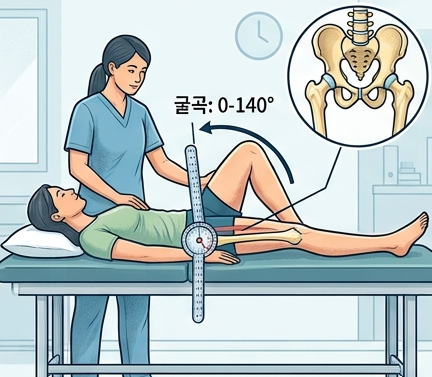
At ANSim Pain Clinic, in patients with lower limb pain, such as in the lower back or knees, hip joint range of motion testing is performed in nearly all patients.