Pain after surgery and pain after fractures
Pain occurring at or near the surgical site after surgery
Hello. I am Dr. Wonsik Ahn, director of ANSim Pain Clinic.
I would like to explain pain after surgery or a fracture.
After surgery, some people at the surgical site or in areas adjacent to it complain of pain.
Surgery is performed in many different situations, such as removing a mass (lump), or, when a bone is broken, attaching a fixation device to help the fracture heal (union).
Direct compression of normal tissue: pain caused by nerve compression
However, even if the ultimate goal of the surgery has been achieved and it was completed without complications, unavoidable chronic side effects can occur.
For example, tissue damaged at the surgical site may form a granuloma and compress normal tissue. In addition, a metal plate or pin inserted during fracture fixation surgery may compress normal tissue.
Such compressed tissue can cause chronic discomfort, and a typical example is "pain" caused by nerve compression’.

Nerves compressed by muscle shortening (numbness, pain, abnormal sensations, etc.)
By a similar principle, even without directly compressing normal tissue, a granuloma, metal plate, or pin can interfere with the activity of nearby muscles and cause muscle shortening. When muscle shortening occurs, the nerves passing between those muscles can be compressed. In conclusion, compressed nerves can cause abnormal sensations such as numbness, or pain. Sometimes people complain of pain so severe that it wakes them from sleep.
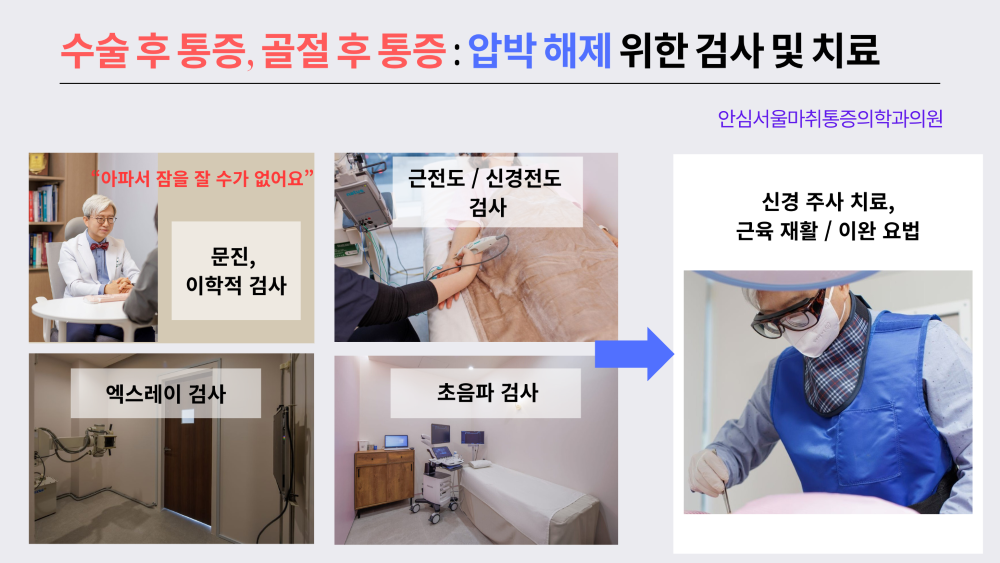
Tests and treatment for "decompression"
When a granuloma, metal plate, shortened muscle, or the like is compressing a nerve, the compressed area must be located precisely and "decompressed."
However, finding these compression points is not as easy as it sounds.
A detailed history and physical examination must be performed, and in addition, the following three types of tests are also needed.
That is, an X-ray to confirm the location of bone or metallic foreign bodies, nerve conduction studies/electromyography (EMG) to determine which of the many nerves is abnormal, from where, and to what degree, and soft tissue ultrasound to examine whether there is soft tissue such as a granuloma and the degree of nerve compression by metallic foreign bodies are needed.
Only through this history, physical examination, and these three essential tests can we identify which nerve is compressed and how, and perform the appropriate "nerve decompression" procedure (mostly nerve injections) so that you can live without pain. In addition, to prevent recurrence after treatment, appropriate muscle rehabilitation or relaxation therapy must be carried out to keep it from coming back.