Sleep and recovery from illness (snoring and sleep apnea)
Hello, I am Wonsik Ahn, director of ANSim Pain Clinic.
When I was a professor of anesthesiology and pain medicine at a university hospital, I "anesthetized" patients every day.
During anesthesia, the body loses consciousness, and various reflexes disappear or function atypically. The sleep we take every day is similar: we lose consciousness, and various reflexes disappear or function atypically.
Then, "How is sleep different from anesthesia?" This was a question I had during my career as a professor of anesthesiology and pain medicine, while repeatedly “putting patients to sleep and waking them up” every day for some 30 years.
Under physiological conditions, humans are active during the day and sleep at night. Sleep requires various hormones, including melatonin, and staying awake also requires various hormones such as cortisol. During anesthesia, powerful drugs that can exceed the effects of physiologically secreted hormones are administered to induce unconsciousness and to induce awakening.
Therefore, from the standpoint of unconsciousness and awakening, there is little difference other than one being physiological and the other artificial.
But why do we commonly tell children, “You have to sleep well at night to grow well”? In addition to cortisol, as shown in the list attached below (only for those interested in medicine), various hormones show cyclic changes. In particular, growth-related hormones are secreted in large amounts at night.
In other words, sleep is not simply a time for the brain to rest, but a key process for repairing and reinforcing body tissues damaged during the day. In other words, sleep time can be called 'the time for maintenance and regeneration of the body's organs'. Especially in young children, growth takes place along with tissue regeneration, which is why people say, “You have to sleep well at night to grow well.”
However, in adulthood, because growth cannot be observed, the major role sleep plays in tissue regeneration, that is, in healing ‘damaged tissue’ and ‘painful tissue,’ is sometimes overlooked. This is why managing sleep quality is very important in patients with damaged tissue, such as pain patients. However, patients who snore have ‘sleep apnea,’ which lowers their oxygen supply. Therefore, for pain patients who snore, receiving sleep treatment in parallel is essential.
[Attached list: Cyclic changes of human hormones]
Hormone | Peak time | Hormone | Peak time |
|---|---|---|---|
Cortisol | Right after waking ↑ (additional rise with CAR) | Aldosterone | Right after waking ↑ |
Free Cortisol (urine) | 24h integrated index | Renin | Night to early morning ↑ |
ACTH | Early morning to morning ↑ | Catecholamine (Epi/NE/Dop) | Morning ↑ |
DHEA-S | Weak circadian rhythm | Metanephrine, Normetanephrine, VMA, HVA, 5-HIAA, MHPG | Morning ↑ |
17-OHCS, 17-KS | Integrated index | Methoxytyramine | Morning ↑ |
TSH | Just before midnight ↑ | Testosterone (men) | Right after waking ↑ (evening -20~30%) |
Free T3 / Free T4 / T3 / T4 / rT3 | Weak circadian rhythm | Free Testosterone | Morning ↑ |
GH | During SWS after sleep onset ↑ | PTH | Nighttime double peak |
IGF-1, IGFBP-3 | GH integrated index | ADH (Vasopressin) | Night ↑ (suppresses nocturia) |
Prolactin | Night ↑ | CTX (β-CrossLaps) | Early morning ↑ |
P1NP | Early morning ↑ | Osteocalcin | Night ↑ |
1,25-(OH)₂ Vitamin D | Daytime ↑ | 25(OH) Vitamin D | Weak circadian rhythm (strong annual rhythm) |
EPO | Night ↑ | Melatonin | 2–4 a.m. ↑ (suppressed by light) |
Leptin | Midnight ↑ | Ghrelin | Pulsatile before meals |
Hepcidin | Morning ↑ | FGF23 | Night ↑ |
Adiponectin | Daytime ↑ |
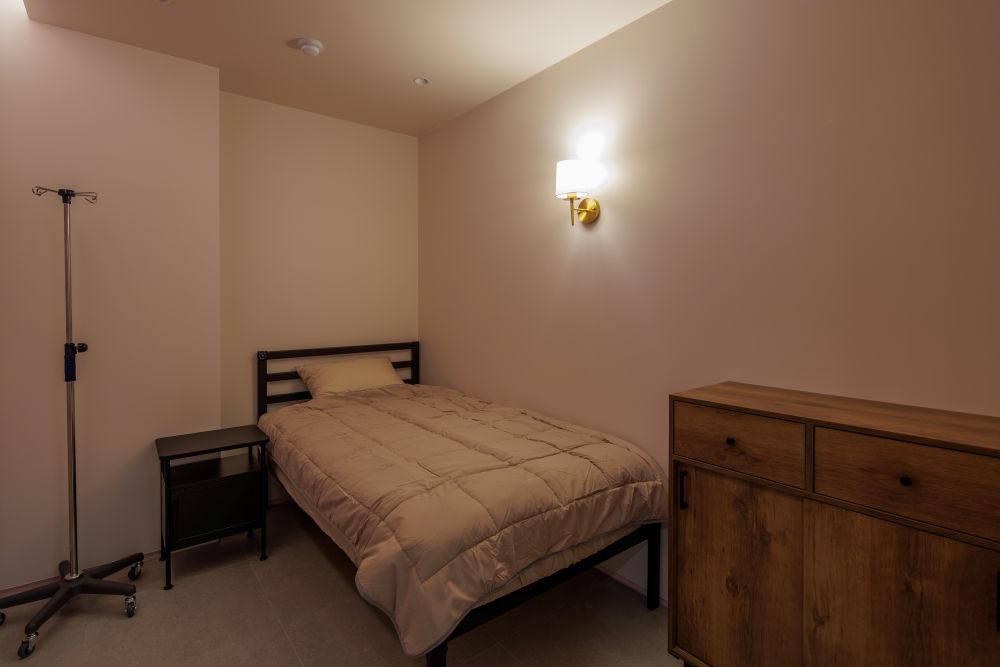
At ANSim Pain Clinic, we perform polysomnography in-house and closely examine for oxygen desaturation during sleep, ‘leg cramps,’ and more. In this way, we help patients secure the good-quality sleep essential for recovery from pain.