
Second-generation Agent Orange aftereffects: specific disease names under peripheral neuropathy
Peripheral neuropathy: a term that collectively refers to multiple diseases
Hello. This is Dr. Wonsik Ahn, director.
Today, among the second-generation Agent Orange aftereffects, we will look at the disease names that fall under "peripheral neuropathy".
Peripheral neuropathy and spinal lesions with lower-limb paralysis are not single diseases; they are terms that collectively refer to multiple diseases. So I told patients the names of several actual diseases.
Then one patient said that they had suffered from ossification of the posterior longitudinal ligament and had surgery, and only later, after the surgery, found out that "ossification of the posterior longitudinal ligament" is one of the spinal lesions with lower-limb paralysis and falls under the second-generation Agent Orange aftereffects.
Thus, peripheral neuropathy and spinal lesions with lower-limb paralysis are not single diseases but terms that refer to multiple groups of diseases, so knowing the specific disease names that belong to each disease group will be the first step toward having a condition recognized as a second-generation Agent Orange aftereffect.
Peripheral neuropathy: specific classification
Because peripheral neuropathy is a lesion that occurs in the peripheral nerves, let us first look at how the peripheral nerves are organized.
Classified functionally, peripheral nerves can be divided into motor nerves, sensory nerves, and autonomic nerves.
Representative motor neuropathies : Guillain-Barré syndrome (sensory and autonomic symptoms are also common), Lou Gehrig's disease (amyotrophic lateral sclerosis), spinal muscular atrophy, etc.
Representative sensory neuropathies: Diabetic peripheral neuropathy (autonomic symptoms are also common), postherpetic neuralgia, etc.
Representative autonomic neuropathies: Gastroparesis, complex regional pain syndrome, orthostatic hypotension, etc.
Peripheral nerves are divided into A, B, and C according to size and conduction velocity. Representative peripheral neuropathies by fiber size are as follows.
Large-fiber (Aα, Aβ) diseases: Chronic inflammatory demyelinating polyneuropathy, Charcot-Marie-Tooth disease, neuropathy due to vitamin B12 deficiency, sensory ganglionopathy (Sjögren syndrome, cisplatin, vitamin B6 excess), etc.
Medium-fiber (Aδ) diseases: Early diabetic neuropathy such as with impaired glucose tolerance, Fabry disease, hereditary transthyretin amyloidosis, erythromelalgia, etc.
Small-fiber (B·C) diseases: Diabetic autonomic neuropathy, autoimmune autonomic ganglionopathy, etc.
Peripheral neuropathy due to hereditary causes, as the term "hereditary" implies, is thought to be a condition that is easily recognized as a second-generation Agent Orange aftereffect.
Peripheral neuropathy due to hereditary causes: Charcot-Marie-Tooth disease, hereditary neuropathy with liability to pressure palsies, hereditary transthyretin amyloidosis, hereditary sensory and autonomic neuropathy, Fabry disease, Friedreich ataxia, etc.
Other peripheral neuropathies can be classified in various ways according to their cause, as follows. For peripheral neuropathy as a second-generation Agent Orange aftereffect, it would seem best to interpret the following causes as having acted as additional aggravating factors on top of a hereditary predisposition that can cause peripheral neuropathy.
Peripheral neuropathy due to metabolic and endocrine causes: Diabetic neuropathy, uremic neuropathy (chronic kidney failure), hypothyroidism-related neuropathy, liver disease-related neuropathy, etc.
Peripheral neuropathy due to nutritional deficiency: Vitamin B12 deficiency neuropathy, vitamin B1 (thiamine) deficiency neuropathy (beriberi), copper deficiency neuropathy, vitamin E deficiency neuropathy, etc.
Peripheral neuropathy due to toxins and drugs: Alcoholic neuropathy, chemotherapy-induced neuropathy (taxanes, platinum compounds, vincristine, bortezomib), drug-induced neuropathy (isoniazid, metronidazole, amiodarone, vitamin B6 excess), heavy metal poisoning neuropathy (lead, arsenic, mercury, thallium), organic solvent and organophosphate poisoning neuropathy, etc.
Peripheral neuropathy due to immune-mediated and inflammatory causes: Guillain-Barré syndrome, chronic inflammatory demyelinating polyneuropathy, multifocal motor neuropathy, paraproteinemic neuropathy (anti-MAG antibody neuropathy, etc.), etc.
Peripheral neuropathy due to vasculitis and connective tissue diseases: Vasculitic neuropathy (mononeuritis multiplex), Sjögren syndrome-related neuropathy, systemic lupus erythematosus-related neuropathy, rheumatoid arthritis-related neuropathy, sarcoidosis-related neuropathy, etc.
Peripheral neuropathy due to infection: Herpes zoster and postherpetic neuralgia, leprous neuropathy, HIV-related neuropathy, Lyme disease neuropathy, diphtheritic neuropathy, hepatitis C (cryoglobulinemia)-related neuropathy, etc.
Tumor-related peripheral neuropathy: Paraneoplastic sensory ganglionopathy (anti-Hu antibody), multiple myeloma- and POEMS syndrome-related neuropathy, amyloid neuropathy (light-chain amyloidosis), nerve infiltration by lymphoma, etc.
Peripheral neuropathy due to compressive and traumatic causes (mononeuropathy): Carpal tunnel syndrome (median nerve), cubital tunnel syndrome (ulnar nerve), peroneal nerve palsy, radial nerve palsy, tarsal tunnel syndrome, etc.
Thus, many disease names are included in the large disease group called "peripheral neuropathy", so it would be a good idea to consult with specialists about the specific disease name and its association with peripheral neuropathy.
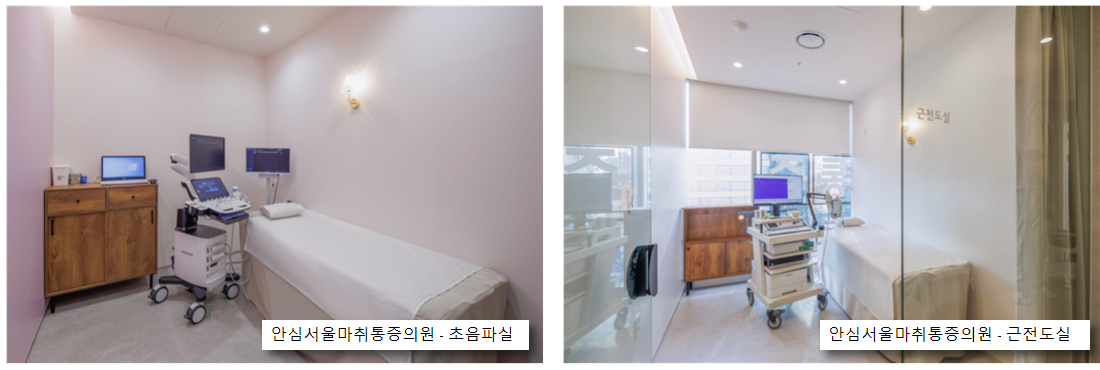
At ANSim Pain Clinic, to make a differential diagnosis of the peripheral neuropathies above, we perform various tests, including nerve conduction studies and electromyography, ultrasound, plain radiography and C-arm imaging, electroencephalography (EEG), and electrocardiography (ECG), as well as blood tests and physical examinations.
** Note) The age of onset of peripheral neuropathy and the symptoms after onset will be covered in the next post.